Open source. The code is on GitHub
AI feed reader, optimized for interest and not for your engagement
Stop scrolling and start reading what's really worth it.
The AI learns from every post you approve or reject. It doesn't decide what you read. It applies your own decisions to hundreds of new posts a day. And when 15 sources cover the same news, you get one story with all the facts instead of 15 near-copies to skim.

Built by Kirill Oleinichenko, editor of Zhurnalus — a weekly design digest, 500+ issues since 2016.
- RSS
- Telegram
- X
- YouTube
- Substack
- Bluesky
- Mastodon
- Product Hunt
- GitHub
- arXiv
Prefer your own server? Run Radaric there for free with your own AI keys: self-hosting guide.
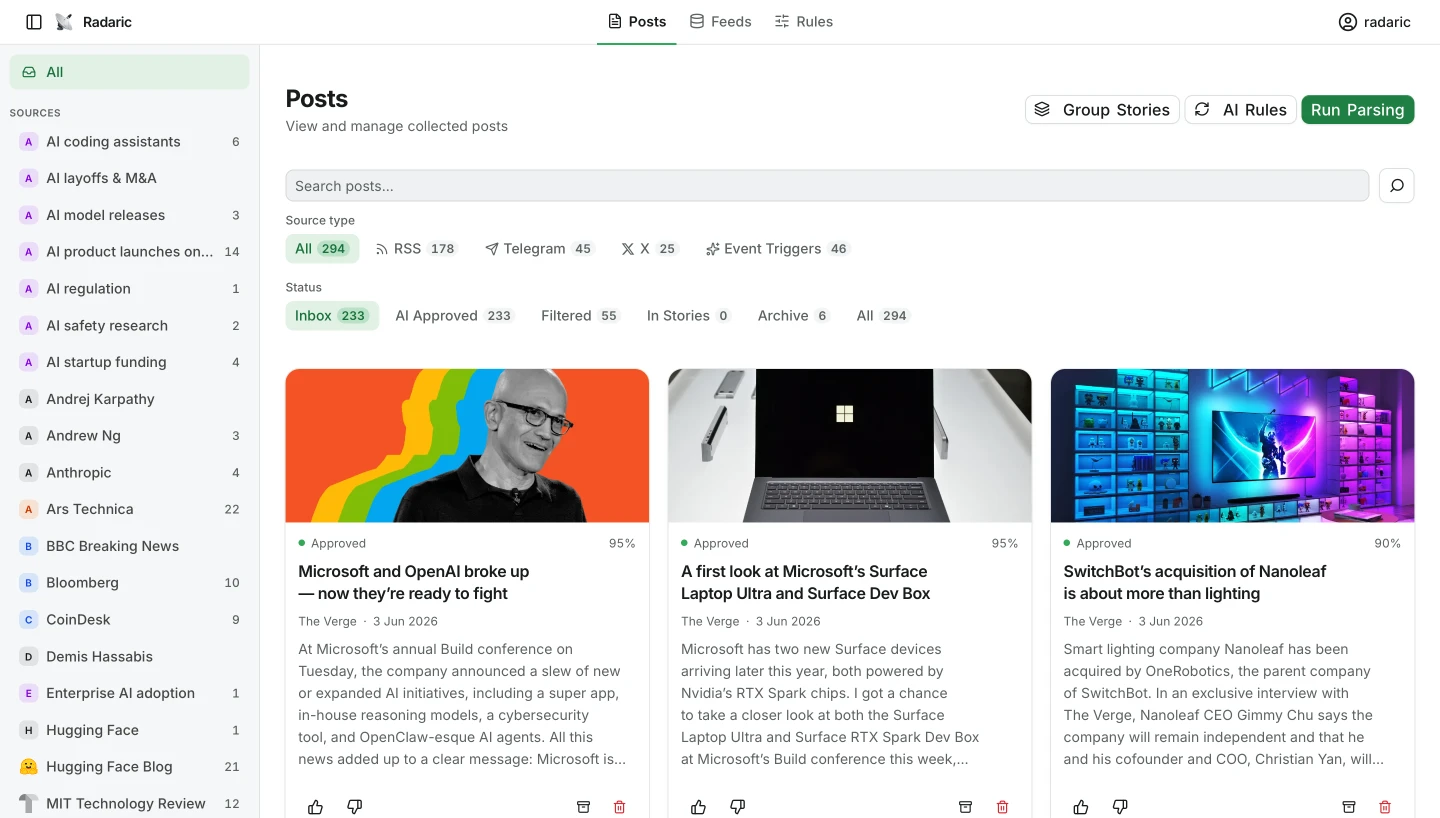
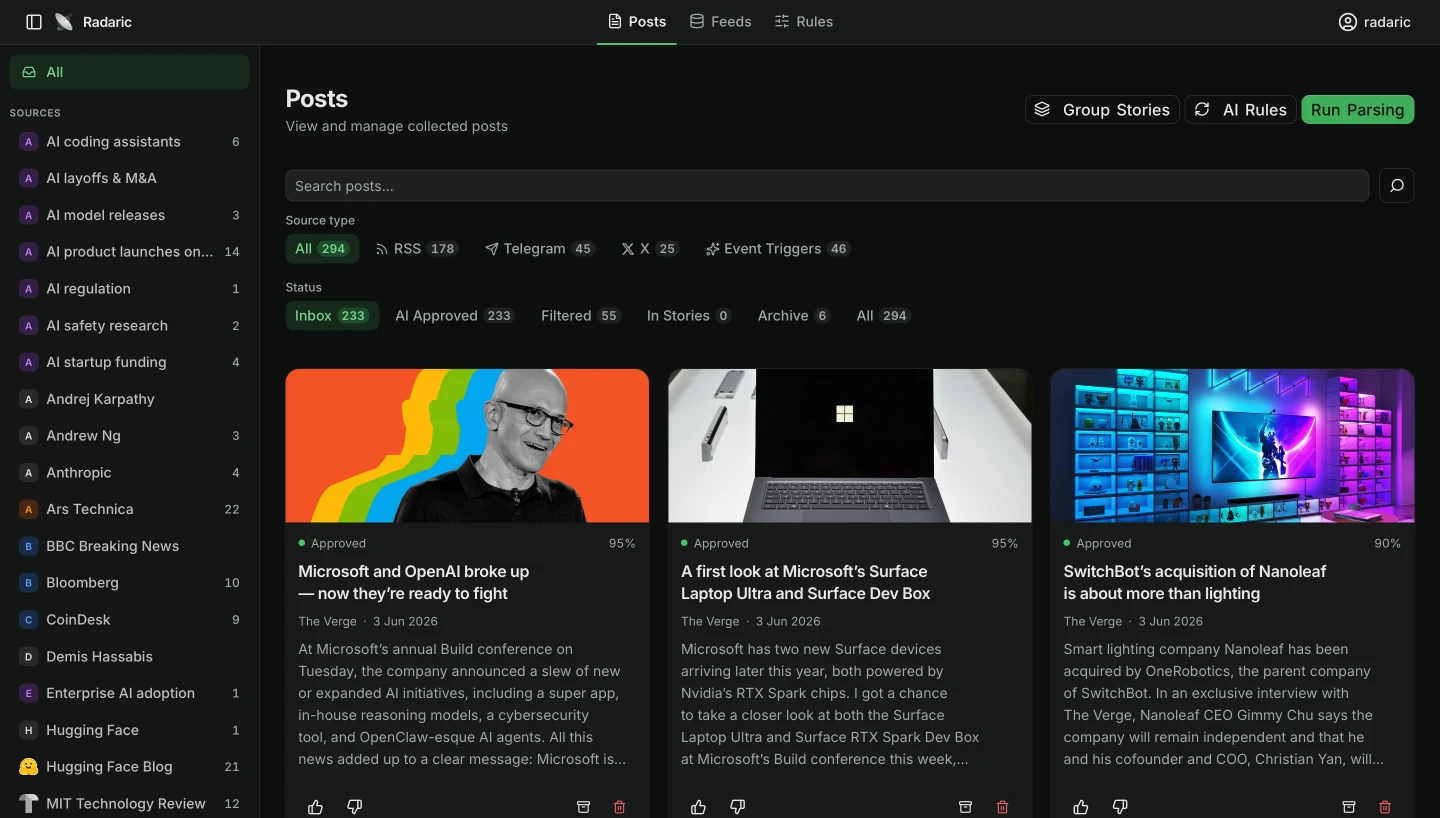
Optimized for your judgment, not your engagement
Four steps from a pile of feeds to a feed that reflects what matters to you.
01 — Connect your feeds
RSS, Telegram (private channels too), Twitter/X, YouTube and Event Triggers, all in one place. For YouTube the AI reads the video transcript for you. Add feeds one at a time, bring a hundred over at once from Feedly or Inoreader with an OPML file, or add Substack, Bluesky, Mastodon, Product Hunt, GitHub and arXiv in one click.
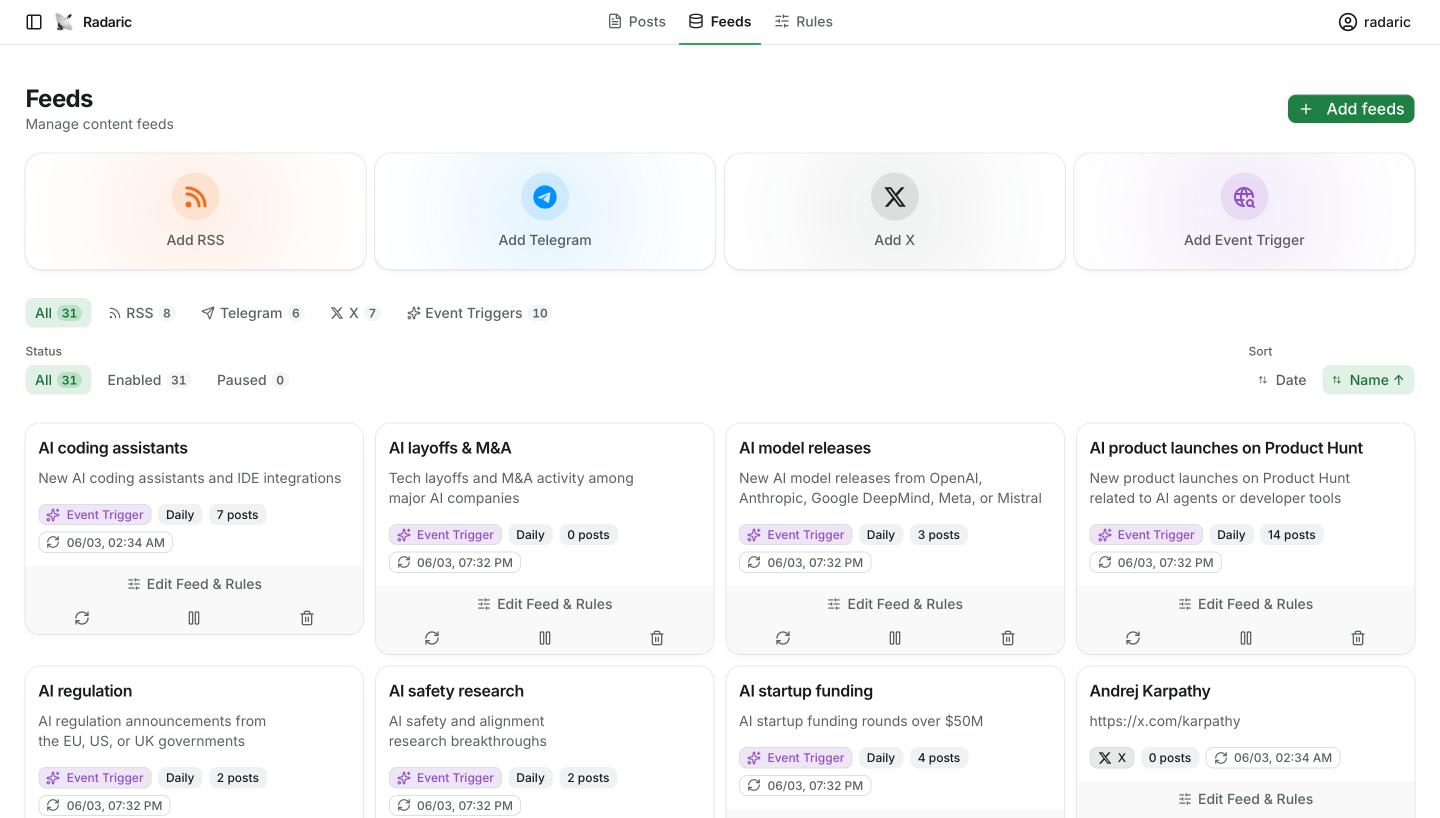
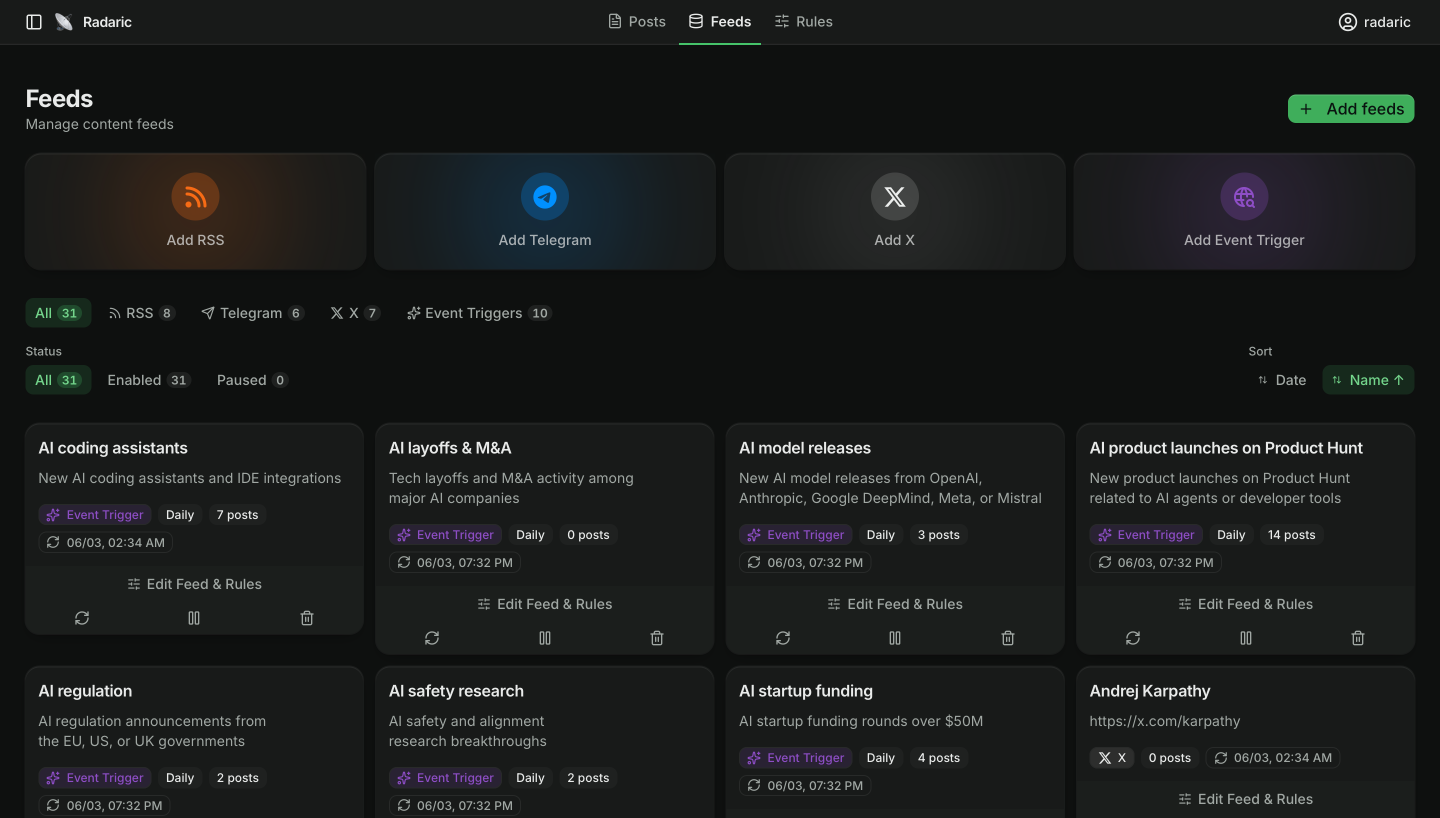
02 — AI filters every item
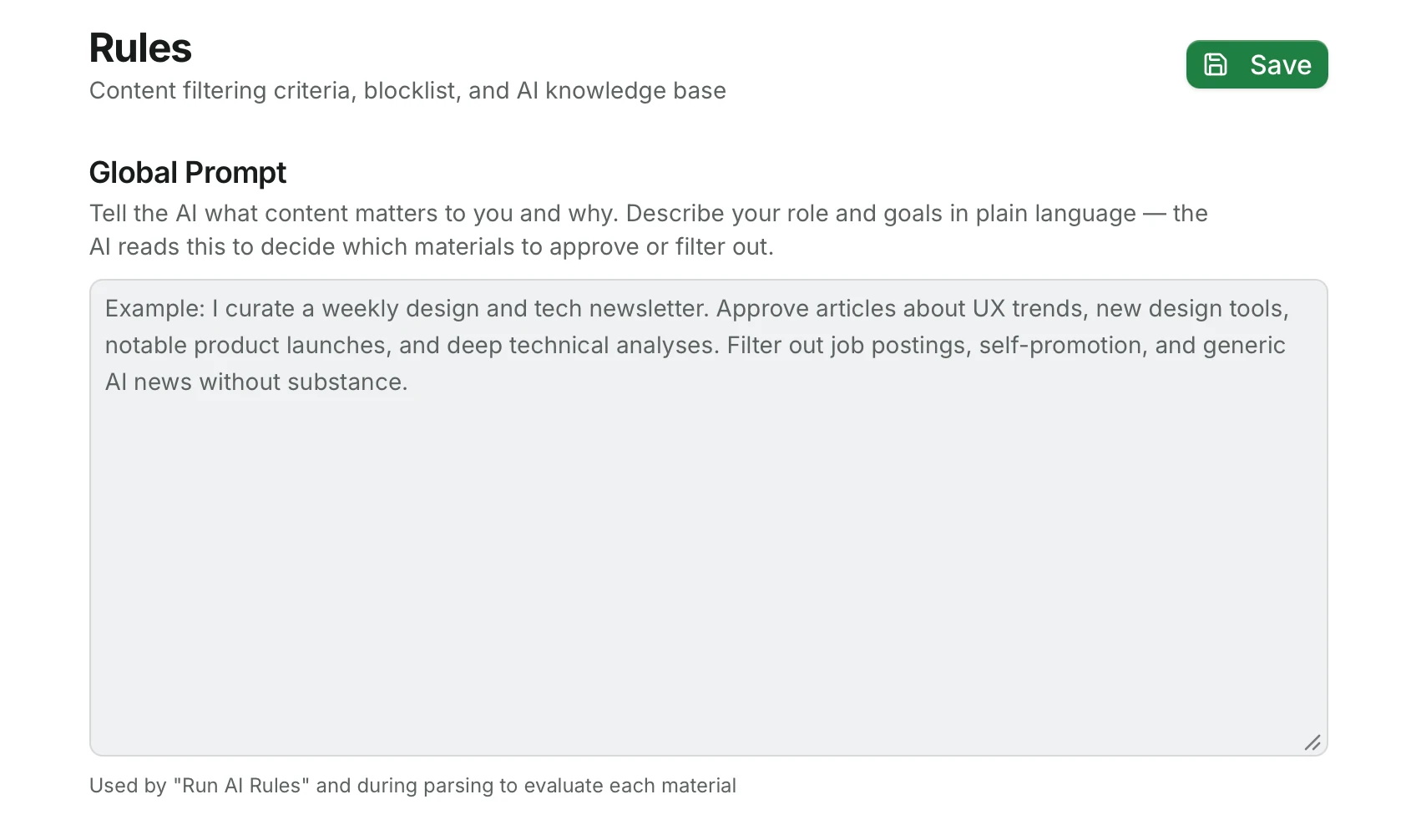
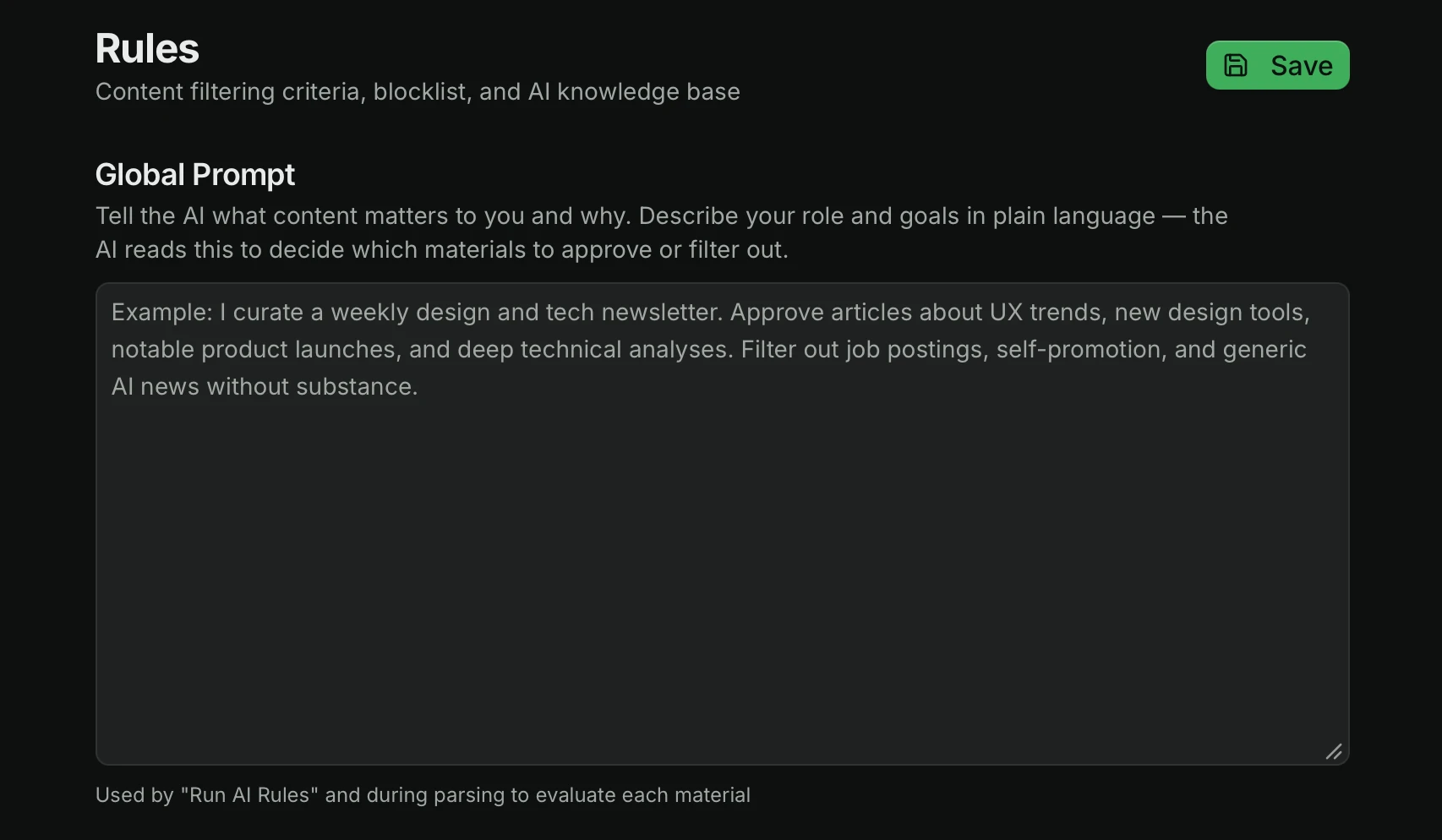
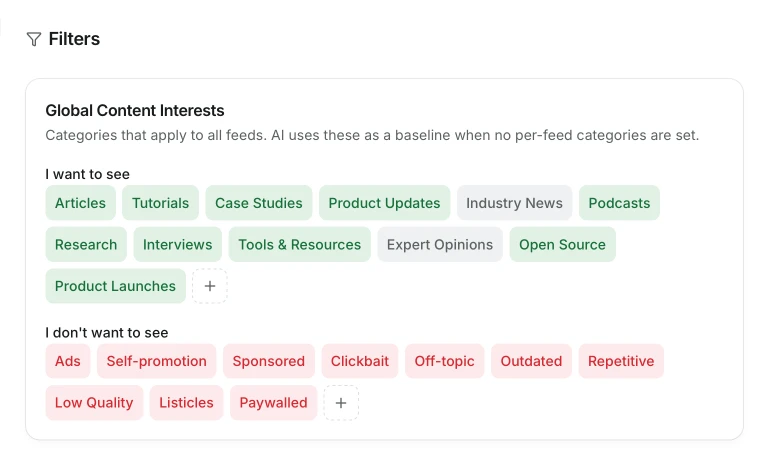
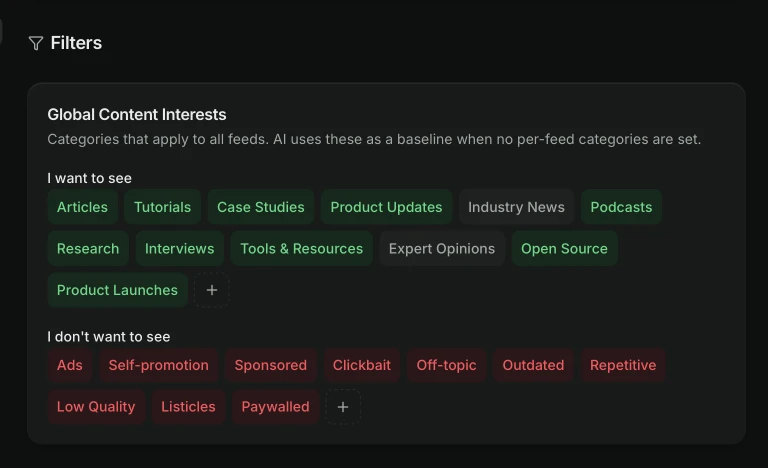
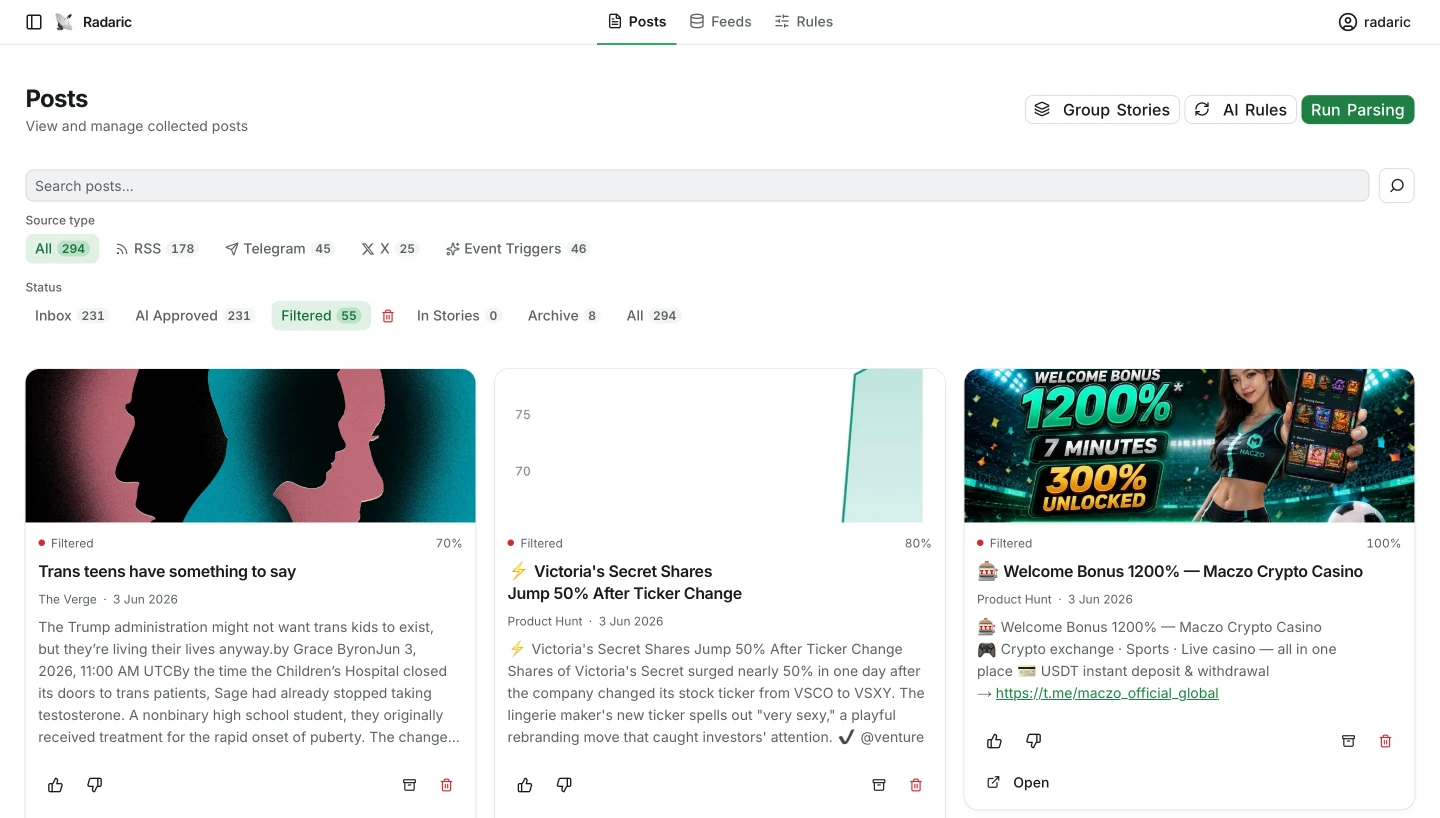
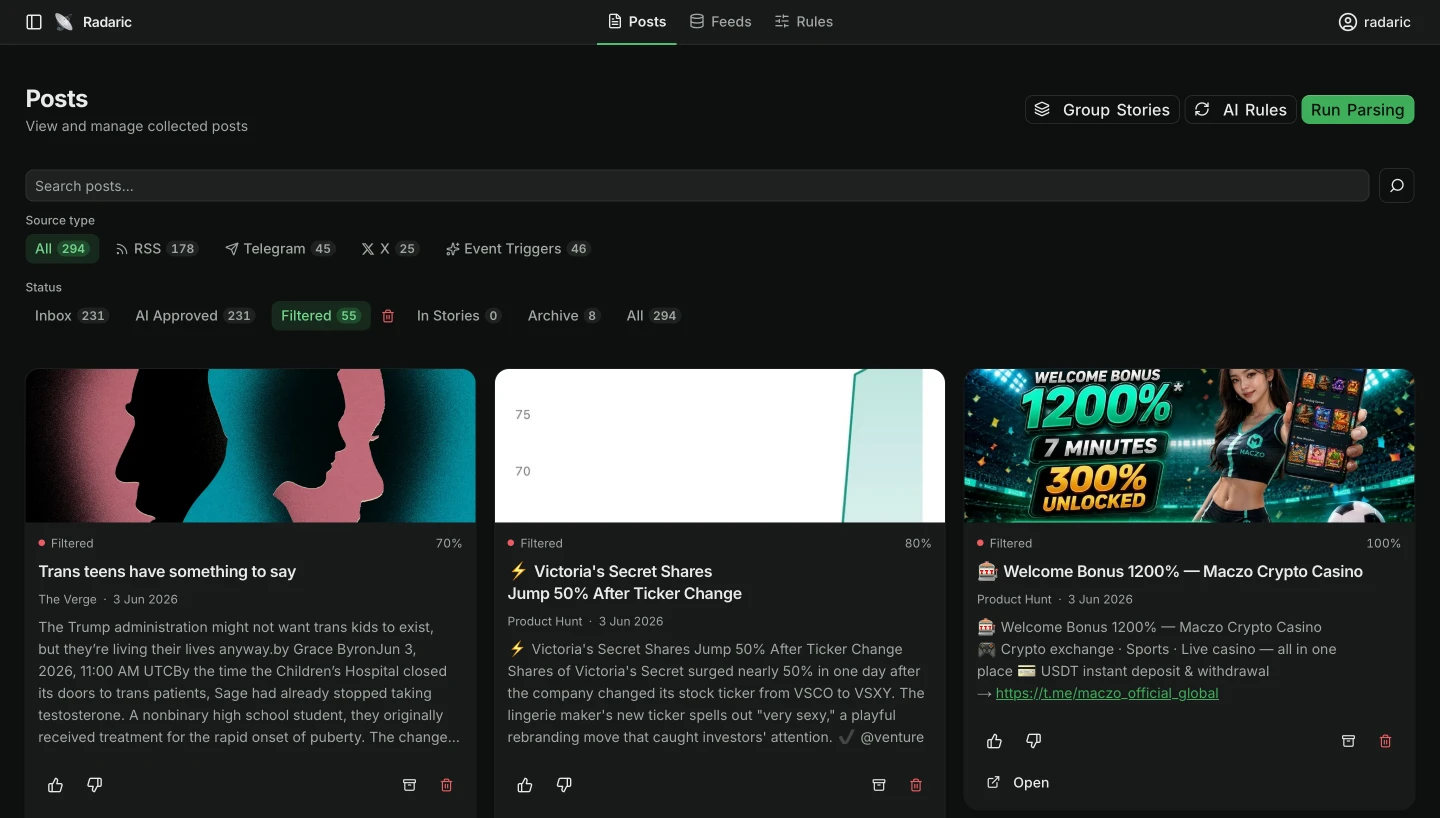
Write down what matters to you in plain words. Every new post is checked against it and gets a confidence score and a short reason. Rejected posts aren't deleted. They sit one click away, so you can always see what the AI threw out and why.
03 — AI learns from you
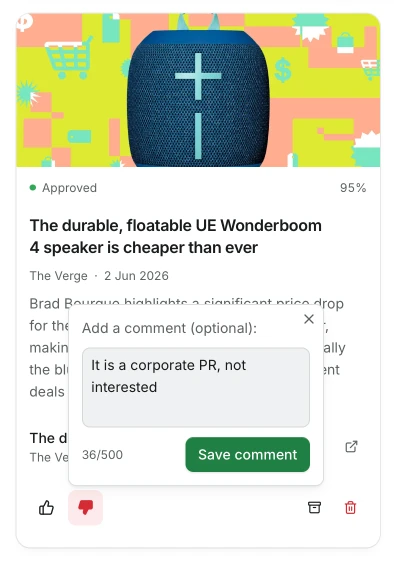
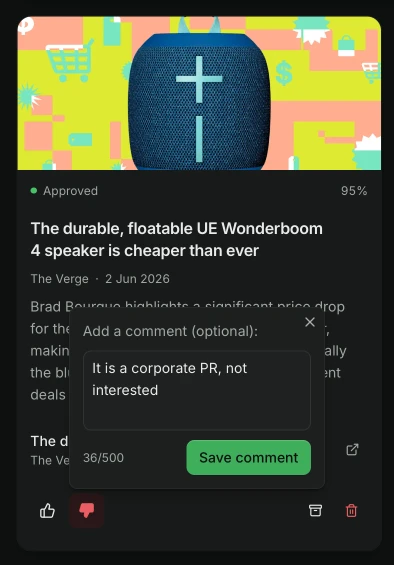
Approve, reject, explain why. Every correction trains your filter, and so does what you save and open. After a few weeks it knows your editorial taste better than you could write it down.
04 — Read what matters
What's left is a short feed of posts that passed your filter. Hours of triage turn into 20 minutes of reading, and every original post is one click away.
Stop reading the same story fifteen times
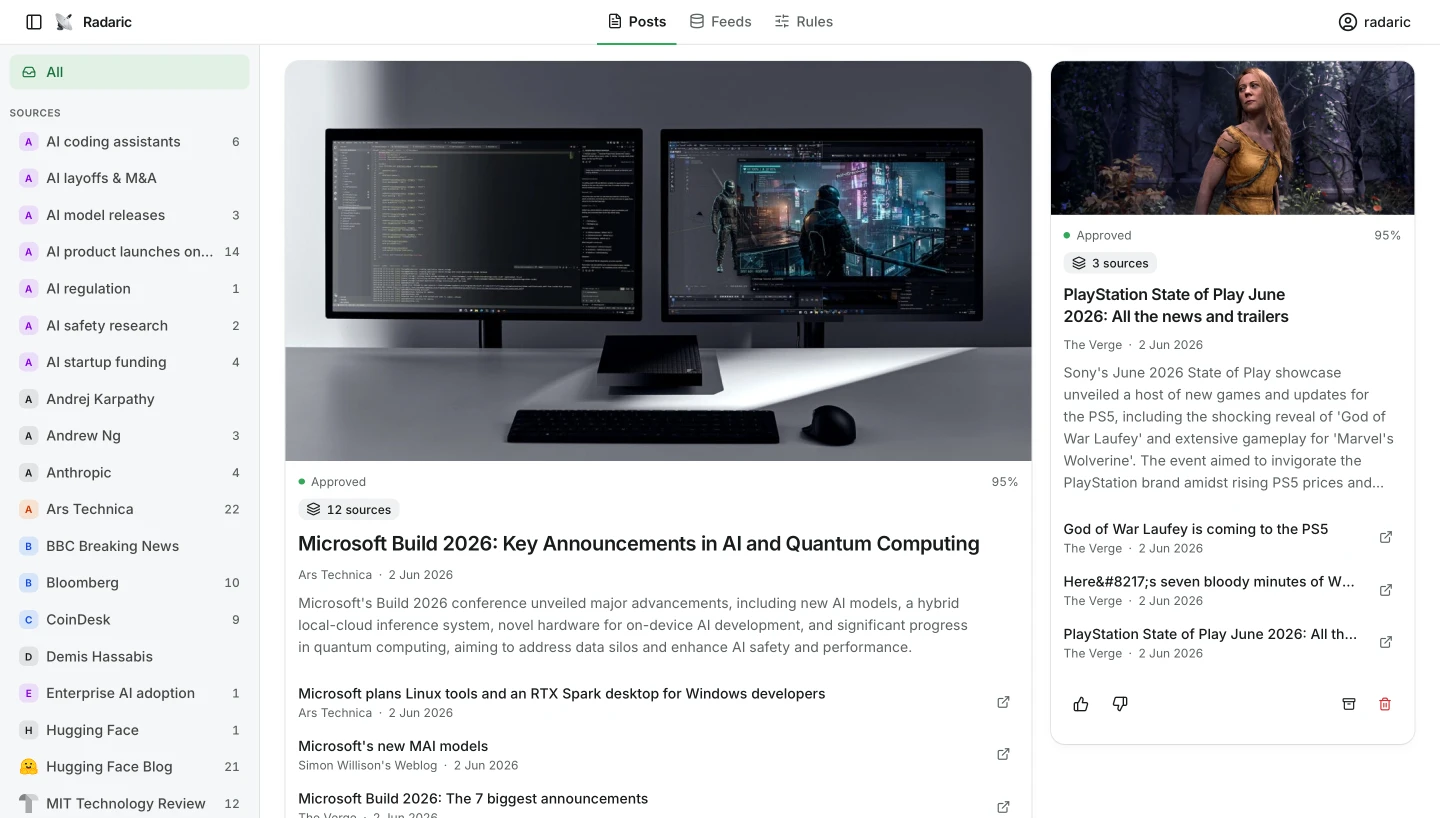
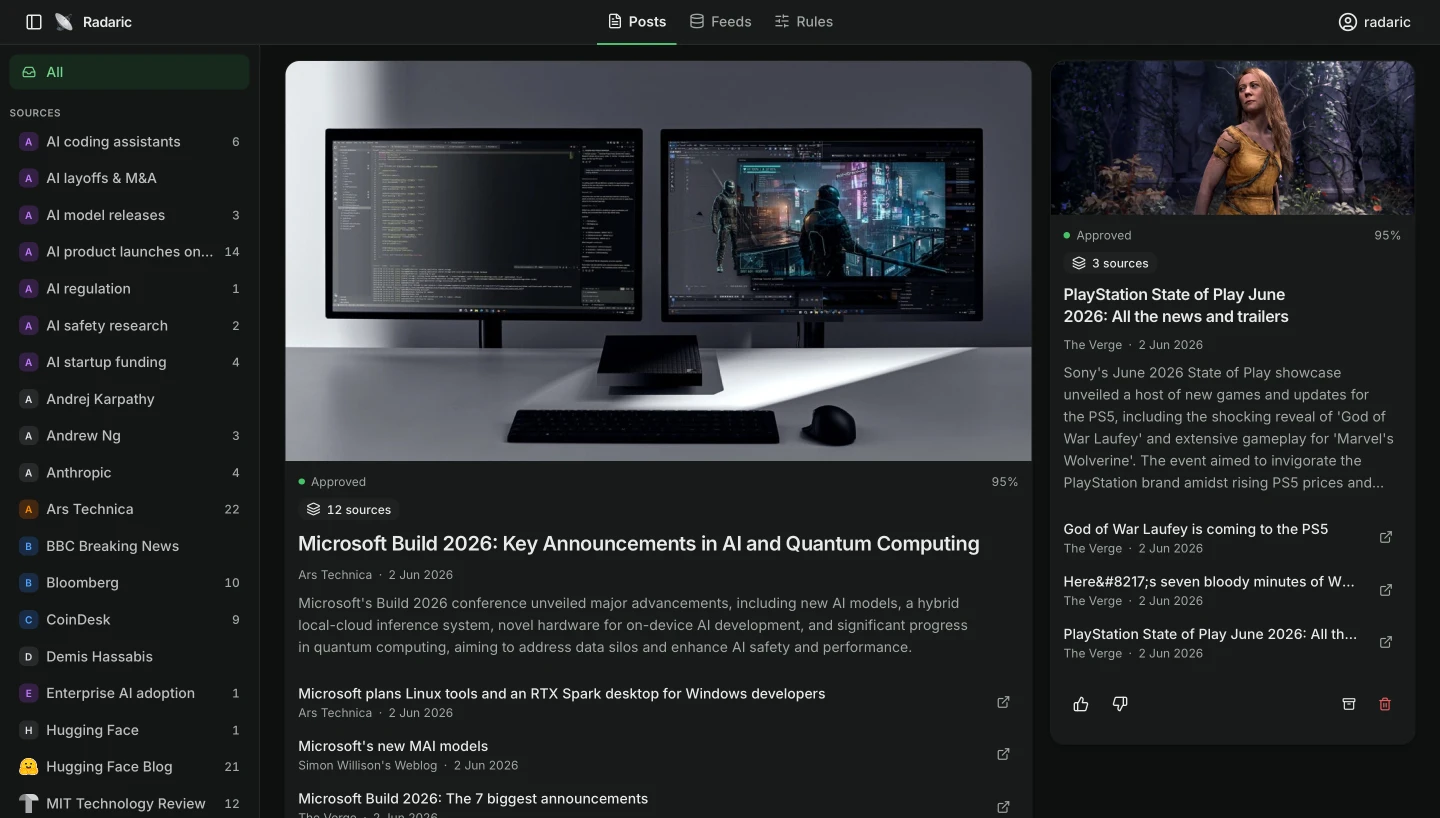
When the same event hits 15 of your channels, Radaric merges them into one story and keeps a link to every source.
How it works
Radaric compares posts from every source you connect: titles, content, the names and entities they mention, and when they were posted. When enough of that lines up, the posts become one story with the key facts pulled together, and each original post stays linked as a source.
Why it matters
You see each piece of news once instead of fifteen times, so the pile feels smaller and you still have every source. It works across sources and languages: a Russian Telegram channel, an English Twitter thread and a Portuguese RSS feed end up in one story when they're about the same event.
How Radaric compares
| Feedly Pro+ | Research assistant | Radaric | |
|---|---|---|---|
| Price | $18/month | $2,000+/month | Free on your server, hosted from $9/month |
| Source code | Closed | — | Public on GitHub |
| Telegram private | No | Manual | Yes, automated |
| Learns your taste | No — same AI for all | After months | After weeks |
| Sources covered | RSS only | All, but manually | RSS, Telegram, YouTube, Substack, Bluesky & more — X on Pro |
| Story dedup | No | Manual | Automatic grouping |
Run it yourself for free, or let us host it
Self-hosted
$0 on your own server
You pay your AI provider directly.
- Every feature, Twitter/X included
- Bring your own keys: OpenRouter or Anthropic for the AI, TwitterAPI.io for X, a Telegram account for channels
- Starts with one Docker Compose command
- Your feeds and data stay on your machine
- Questions and fixes go through GitHub issues
- Free for you and your company under AGPL-3.0
Lite
$9 /month · $90/year
Yearly is 2 months free.
- Feeds from RSS, Telegram, and YouTube
- Substack, Bluesky, Mastodon, Product Hunt, GitHub, arXiv — one click to add
- AI reads YouTube video transcripts
- AI filtering with feedback learning
- Story Aggregator
- Private Telegram channel support
- See the AI's reason for every decision
- Twitter/X accounts — not included
Pro
Recommended$59 /month · $499/year
Yearly saves $209 vs. monthly.
- Everything in Lite
- Twitter/X account parsing
- 30-day money-back guarantee
Early users get direct access to the developer. This won't scale.
Lite and Pro come with a 30-day money-back guarantee.
Frequently asked questions
How is this different from Feedly or Inoreader?
Feedly and Inoreader are RSS readers, and their AI is the same for every user. Radaric also reads Telegram (private channels included), Twitter/X and YouTube, where the AI works from the video transcript, which no RSS reader does. The bigger difference: it learns from your approvals and rejections, so the filter is yours and gets sharper with every decision.
Is my Telegram account safe?
Radaric's connection to Telegram is read-only. It reads messages and never sends, modifies or deletes anything in your Telegram account. Your credentials are stored encrypted.
Can I run Radaric on my own server?
Yes. The full code is on GitHub under the GNU Affero General Public License (AGPL-3.0). You can run it, change it and use it inside your company for free, with your own AI keys. If you change the code and run it for other people, colleagues included, the license requires you to offer them the source of your version. The self-hosting guide walks you through setup with Docker Compose.
Who built this?
Radaric is built by Kirill, the editor of Zhurnalus — a weekly design digest with 500+ issues over 10 years. He built Radaric to solve his own curation problem: scanning hundreds of feeds every day. It's been in daily use since November 2025.